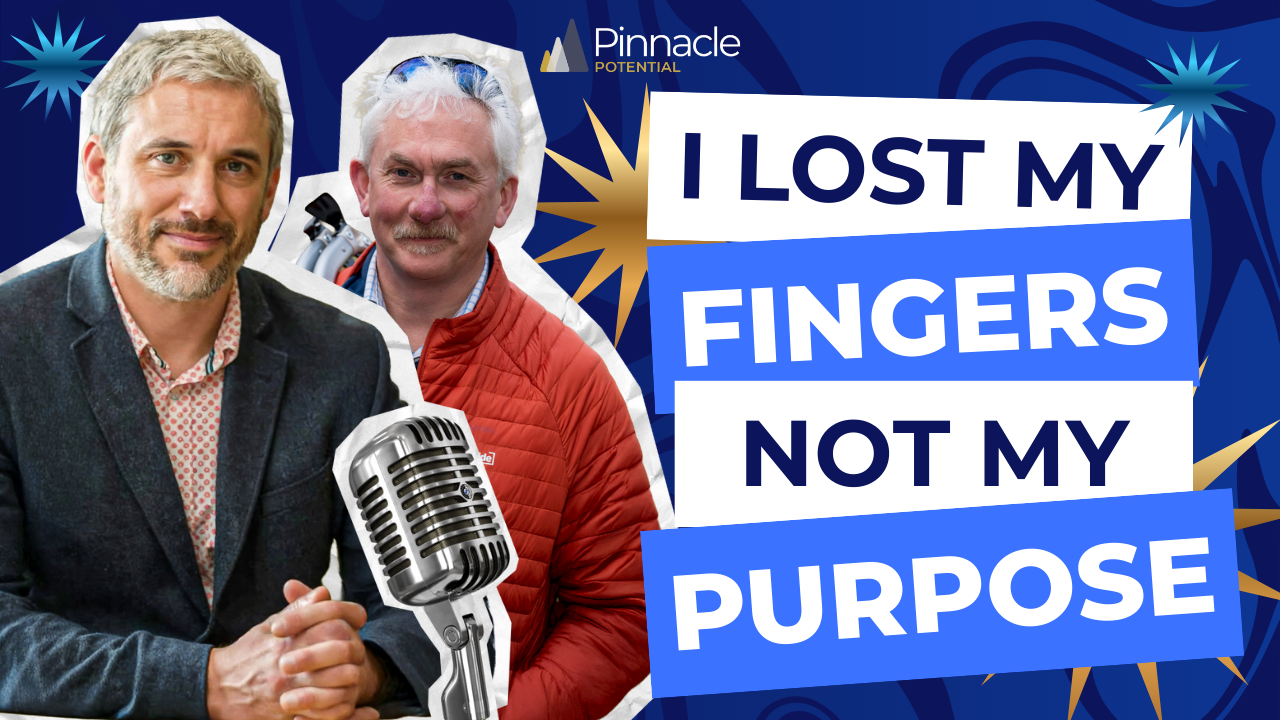
In this episode of The Business of Thinking, Richard Reid is joined by mountaineer and keynote speaker Nigel Vardy, a man many know as “Mr Frostbite.” What begins as a conversation about climbing quickly becomes something deeper: a raw look at adversity, identity, and the psychology of staying calm when everything is on the line.
Nigel’s early life was shaped by the outdoors. Growing up in Derbyshire, he spent much of his childhood outside, partly by choice, partly by necessity. As a child he suffered with persistent coughing, and a doctor advised his mum to keep him outdoors as much as possible. That simple instruction became formative: long hours in a big garden, time on a dairy farm, hillwalking with family, and eventually mountaineering.
Alongside climbing, Nigel built a near 40-year career in electrical engineering within the utilities industry, an environment that, like mountaineering, demands high levels of organisation, skill, and decision-making. As Nigel explains, both worlds carry consequences. In engineering you’re responsible for systems that affect thousands of people; on a mountain you’re responsible for life and death in real time. Richard picks up on the parallels: both are “24/7” arenas where panic doesn’t help and preparation matters.
That theme becomes sharply real when Nigel recounts the defining moment of his life: Denali, Alaska, April/May 1999. Three climbers, Nigel, Steve and Anthony, were caught near the summit in a brutal storm. At around 20,000 feet there’s no quick escape, no warm car, no door to shut. There is only exposure and decision-making. As Nigel puts it bluntly: if you don’t act quickly, you die.
So they did what experienced people do under pressure. They focused on the next best step. They dug a snow hole and spent the night fighting for survival in conditions where temperatures were reported to reach minus 60°C. The following day they attempted to descend. Steve went for help, but fell and broke his legs. Anthony stayed with Nigel. Eventually, after distress calls and a major search effort, all three were airlifted to hospital in Anchorage.
What followed was the second mountain, and in some ways the harder one.
Nigel was 30 years old and faced the possibility of losing limbs. But what hit him just as powerfully was the psychological shock of losing control. As a control engineer, he was used to issuing control and managing systems. In a hospital bed, he had to “hand control” of his life over to nurses, consultants and carers. He couldn’t feed himself. He couldn’t brush his teeth. He couldn’t even reliably press a call button , sometimes he had to try with an elbow. For eight and a half weeks, he couldn’t stand.
Richard reflects on how profound that shift is: not just a change of pace, but a complete reversal of autonomy. Nigel is honest about how he coped at first: badly. Sleep was disrupted by the need to keep arms raised to drain swelling, “like being crucified,” he says. Mentally, he spiralled. What helped was support, his sister flying out, then returning home to be closer to family and friends, and moving into specialist care. His point is simple and powerful: when you can’t go to people, they have to come to you, and that love and reliability matters more than most of us realise.
Physically, the injuries were extensive: the tips of all fingers amputated, both thumbs affected, all toes lost, damage to heels and the ball of the foot, and facial injury requiring later reconstruction, his nose ultimately grafted from his forehead. But the story isn’t only about injuries; it’s also about identity. Nigel admits he feared nobody would want to know “a man with a scarred face and no fingers.” Yet he discovered something important: the inside was the same, only the outside had changed.
Recovery wasn’t linear. Nigel describes progress as leaps forward followed by setbacks, surgeries that failed, grafts that didn’t take, and repeated returns to bed just when he’d regained momentum. His strategy was perspective: keep an eye on the bigger picture. Put patience and effort in early, so the future can be better.
One of the most vivid examples of reclaiming control is Nigel’s “IKEA story.” Friends took him out in a wheelchair , and IKEA, with its flat floors and wide aisles, was the perfect test environment. In the handle section, he asked to be left alone so he could physically test what he could grip and pull. It’s a moment that captures his engineering mind and his determination: don’t design life around limitations; redesign the environment and find what works.
That philosophy runs through Nigel’s approach to disability and performance. He’s blunt: adaptions can help, but the real work is adapting yourself. He taught himself to write again in three days because he wanted independence, not gadgets. He also challenges modern culture’s obsession with speed, screens and shortcuts. You can’t learn mountaineering, engineering, or life from a TV screen, he says. You have to be “up to your knees in it.”
For business audiences, Nigel’s lessons are strikingly practical:
* Stay calm when it goes mad. Panic spreads; composure stabilises.
* Assess first, like paramedics. Don’t rush into danger and create more casualties.
* Focus on what you can do, not what you can’t. 85% progress beats 0% perfection.
* Put the apprenticeship in. Mastery comes from time, repetition, and learning on the job.
* Reassess constantly. A plan is essential. but it must flex with changing conditions.
Richard reinforces the broader psychological message: growth rarely comes from comfort. Nigel agrees, especially when speaking to children: the comfort zone might feel safe, but it teaches you nothing. Discomfort, managed sensibly, is where learning happens.
The episode closes on a final, grounded truth: decisions must be made with the information you have, and you must stand by them. But you also must be willing to change when circumstances change. The storm shifts. The terrain changes. Life changes. And as Nigel’s story proves, you can still move forward, sometimes not by doing what you once did, but by supporting others, sharing knowledge freely, and redefining what strength looks like.
Nigel also shares that a documentary, Frostbitten, follows him returning to Denali 25 years later to find and thank the people who saved him, a full-circle reminder that survival is rarely a solo act, and resilience is as much about community as it is about willpower.