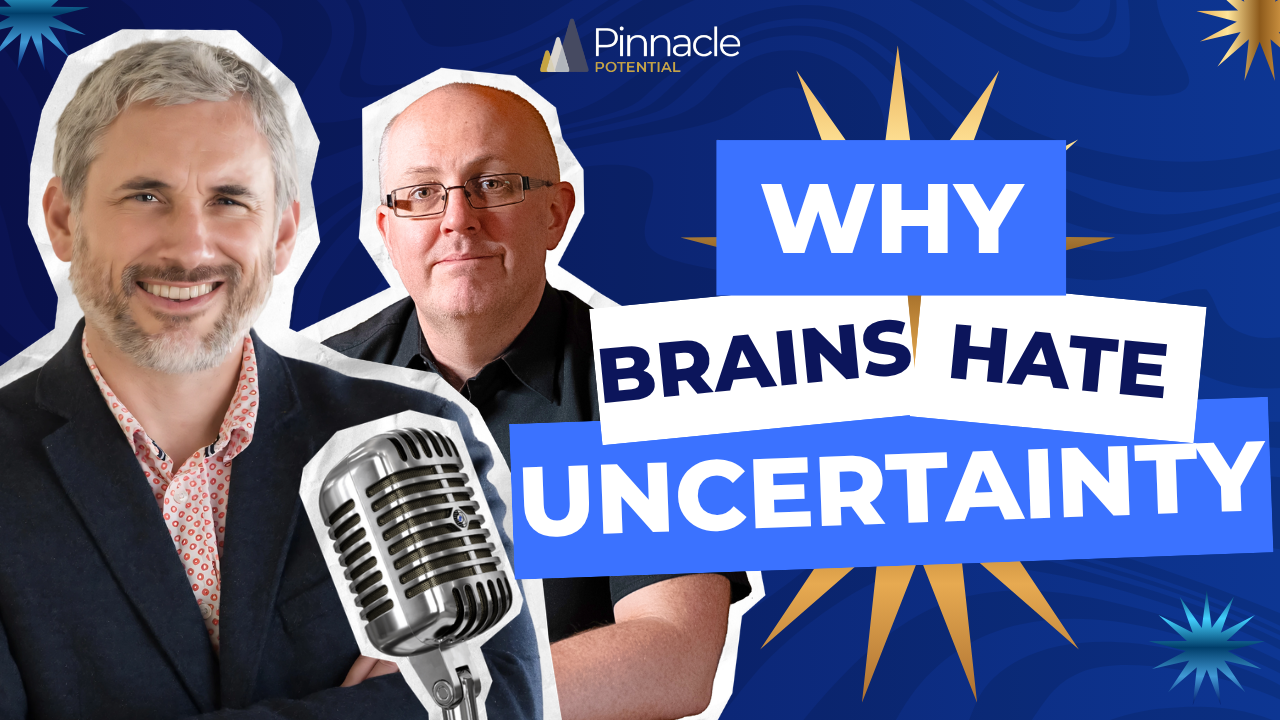
In this episode of The Business of Thinking, Richard Reid is joined by neuroscientist and author Dr Dean Burnett for a fascinating conversation about what the brain really does — and just as importantly, what it doesn’t.
Dean is best known for making neuroscience accessible, often by challenging the myths that have become accepted as fact. One of the biggest examples is the old claim that humans only use 10% of their brain. As Dean explains, this is wrong in both directions. We use all parts of the brain in some capacity, but we cannot suddenly “unlock” huge dormant reserves and become superhuman. The brain is already an energy-hungry organ, working hard all the time just to keep us alive, functioning and able to think.
That point matters because many modern ideas about productivity, potential and personal optimisation are built on oversimplified assumptions. We often talk as if the brain has endless spare bandwidth waiting to be activated, but in reality, cognitive capacity is limited. That has huge implications for work, stress and performance.
One of the clearest takeaways from the episode is Dean’s point that the brain is deeply uncomfortable with uncertainty. Humans are wired to want safety, predictability and a degree of control over what happens next. In the workplace, that means change initiatives, restructuring, unclear expectations or a lack of communication can trigger far more stress than leaders often realise. It is not simply that people are being resistant, dramatic or negative. Their brains are responding exactly as human brains tend to respond when the future feels unstable.
This is where neuroscience becomes incredibly practical. If managers understand that uncertainty is inherently stressful, they can lead differently. Communication, reassurance and acknowledgement become far more important. Even if a difficult change is unavoidable, people cope better when they feel informed and taken seriously. As Richard points out during the conversation, engaging people and listening to their concerns often matters just as much as the technical detail of the change itself.
The discussion also explores job satisfaction and why money alone rarely explains whether people feel fulfilled at work. Dean highlights something simple but powerful: the brain likes to see a connection between effort and outcome. We are far more satisfied when we can recognise the results of our labour and feel that what we do has led to something tangible. That is why professions like teaching, engineering or gardening can create strong feelings of meaning — people can see evidence of their contribution.
By contrast, many modern office roles feel more abstract. People may work hard on projects for months, only for them to be shelved, restructured or redirected. Even if they are still being paid, the brain does not always register that as satisfying. Recognition, visibility and appreciation matter because they help restore that missing link between effort and value.
Another major topic in the episode is multitasking. Dean explains that the brain does not truly do several complex things at once. Instead, it rapidly switches attention between tasks while holding some information in working memory. This can create the feeling of multitasking, but only within limits. The more complex the tasks, the less effective this becomes. Push beyond your cognitive capacity and the system starts to break down.
That is a particularly useful reminder in today’s work culture, where constant switching is often mistaken for effectiveness. Many people pride themselves on doing everything at once, but neuroscience suggests there is a cost. The brain has finite resources, and when too much is loaded onto it, performance suffers. That is why burnout cannot simply be solved with resilience workshops or stress management tips if the underlying workload remains unrealistic.
Dean is refreshingly honest about this. While techniques like mindfulness or training can help, they do not magically create infinite capacity. Sometimes the problem is not that the individual is coping badly — it is that the demands are too great. That distinction matters.
There is also a useful challenge in the conversation around personality profiling and quick-fix workplace tools. Dean is sceptical of simplistic models that promise to sort people neatly into categories and then manage them accordingly. Humans are too complex for that. The better approach, he argues, is to understand that every individual brings their own motivations, fears, habits and reactions. Good management starts with recognising that employees are not abstract resources — they are human beings with human brains.
That may sound obvious, but it is often forgotten.
What makes this episode so valuable is that it strips away some of the hype around neuroscience while still showing how useful it can be. You do not need grand claims about unlocking hidden brain power. The real value lies in understanding how people actually think, feel and respond under pressure.
And in a workplace that is increasingly fast, uncertain and demanding, that understanding could make all the difference.
Listen to the full podcast episode now.