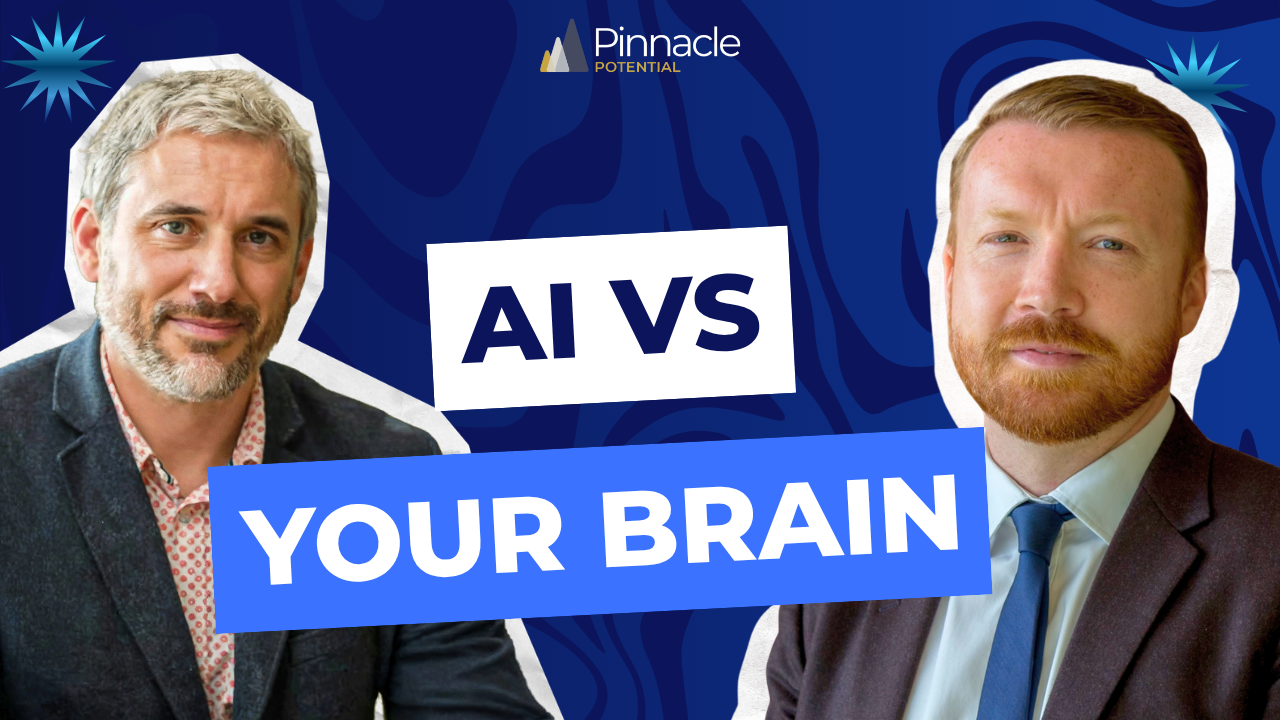
In this episode of The Business of Thinking, Richard Reed is joined by performance psychologist Jon Finn, founder of Tougher Minds, to explore a powerful idea:
Your business isn’t run by people. It’s run by brains — and brains are run by habits.
It’s a simple shift in perspective, but one that completely reframes how we think about performance, leadership and the future of work.
The Real Driver of Performance: Habits, Not Knowledge
One of Jon’s key insights is that most traditional approaches to performance are flawed.
For years, organisations have focused on knowledge — assuming that if people understand what they should do, they’ll do it.
But neuroscience tells a different story.
The brain’s primary job is to conserve energy, and the most efficient way to do that is through automation. That means most of what we think and do is habitual — not conscious.
In fact, Jon suggests that:
- Up to 98% of our thinking is automatic
- Behaviour is driven by what we’ve practiced, not what we know
This explains a huge frustration in both personal development and business:
People don’t struggle because they lack knowledge.
They struggle because their habits don’t align with that knowledge.
Resilience, Reframed
“Resilience” is one of those overused business buzzwords — but Jon brings clarity by breaking it into two distinct parts:
- Awareness – noticing your thoughts and behaviours
- Control – being able to change them
Most people can do the first part.
They know when they’re procrastinating, overwhelmed, distracted, or stuck.
But the second part — changing behaviour — is where things fall apart.
And that’s because behaviour change isn’t about motivation.
It’s about rewiring habits.
This is where Jon introduces the idea of becoming a “habit mechanic” — someone who understands how to intentionally reshape the automatic patterns that drive performance.
The Three Brain States That Define How You Work
A central concept in the conversation is Jon’s model of three brain states:
1. Recharged State
Rest, recovery, sleep — essential for cognitive performance
2. Medium-Charge State
Routine, repetitive, procedural tasks
(e.g. emails, admin, scheduling)
3. High-Charge State
Deep thinking, decision-making, creativity, problem-solving
Here’s the problem:
Most people — and most organisations — are stuck in medium-charge mode.
Constant notifications, emails and digital overload have conditioned us into shallow, reactive work.
Why AI Is Forcing a Rethink of Human Value
This is where the conversation takes a powerful turn.
Jon explains that we’re entering a world where AI can now perform medium-charge tasks — faster, cheaper and often more accurately than humans.
That means:
- Routine work is being automated
- Entry-level roles are shrinking
- Businesses are becoming leaner
In some cases, companies are already:
- Reducing headcount
- Replacing procedural work with AI systems
- Increasing profit while reducing employment
This shift is already happening — not in theory, but in real organisations.
The New Competitive Advantage: High-Charge Thinking
If AI owns the medium-charge space, where does that leave humans?
According to Jon:
The future belongs to high-charge thinkers
People who can:
- Solve complex problems
- Think critically
- Make decisions under pressure
- Work creatively alongside AI
But here’s the catch…
High-charge thinking is mentally expensive.
It requires:
- Energy
- Focus
- Recovery
- Psychological safety
You can’t operate in that state all day — and most people aren’t set up to access it consistently.
Why Most AI Strategies Are Failing
One of the most practical insights from this episode is this:
Most organisations are approaching AI backwards.
They’re:
- Buying tools
- Rolling out training
- Ticking boxes
But they’re missing the most important piece:
How humans actually think and work
Without understanding:
- Brain states
- Cognitive load
- Habit patterns
…AI becomes just another layer of overwhelm.
As Jon puts it, giving someone AI without understanding their brain is like:
Teaching someone how an engine works and expecting them to become a better driver.
What Businesses Should Be Doing Instead
The smarter approach is far more strategic:
- Map your tasks
- What is medium-charge vs high-charge work?
- Automate the routine
- Use AI for procedural, repeatable processes
- Elevate your people
- Free them up for high-value thinking
- Train the brain, not just the tools
- Focus on habits, attention and cognitive performance
This is what Jon calls building a “brain-state intelligent culture.”
The Bigger Shift: From Employees to Cognitive Performers
Perhaps the most important takeaway from this episode is this:
We are moving from a world of employees…
to a world of cognitive performers.
Just like elite athletes train their bodies, future professionals will need to train their brains.
Because in a world where AI can think faster and cheaper…
Your value will come from how well you think — not how much you do.
Final Thought
This episode isn’t just about AI.
It’s about understanding the human operating system behind everything we do.
Because if you don’t understand your brain…
You won’t get the best out of your people.
And you definitely won’t get the best out of AI.
Listen to the full podcast episode now.