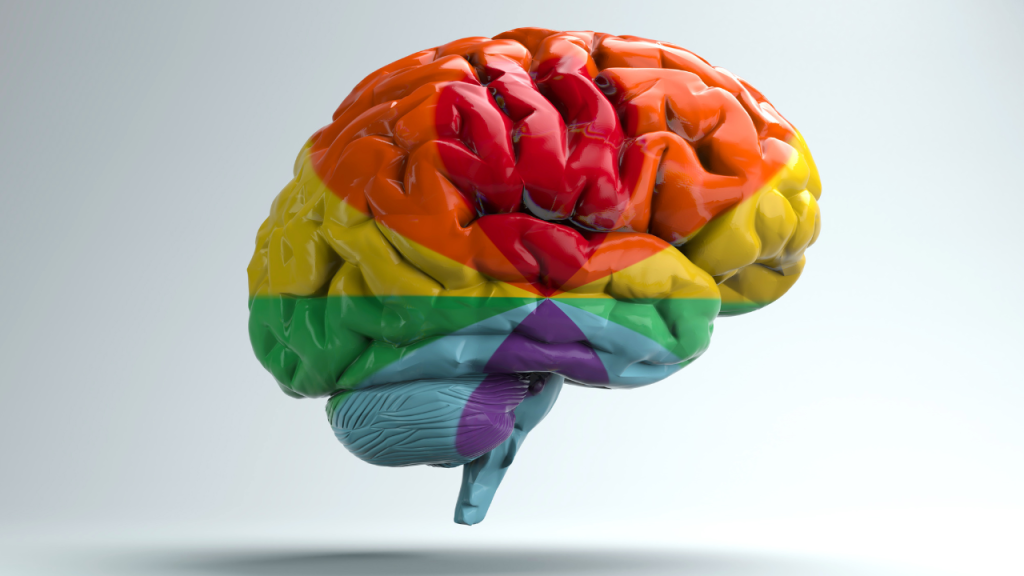
In this episode of The Business of Thinking, Richard Reid is joined by author, coach and former professor Loretta Breuning to explore a fascinating question: what if many of the behaviours we think of as uniquely human are actually deeply rooted in our mammalian wiring?
Loretta’s work focuses on four key “happy chemicals” — dopamine, serotonin, oxytocin and endorphin — and the role they play in shaping motivation, social comparison, stress and decision-making. Her central argument is both simple and disruptive: much of what drives us today is not just culture, rational thinking or modern circumstance, but ancient survival circuitry that still operates beneath our awareness.
One of the most interesting threads in the conversation is the distinction between the brain we think with and the brain that actually drives many of our emotional responses. Loretta explains that our verbal, rational brain often creates stories to explain how we feel, but those feelings are generated by older, nonverbal systems designed for survival. That means we are often far less objective than we imagine.
Take dopamine, for example. Loretta describes it not as the pleasure of reward itself, but as the excitement of anticipating a reward. In survival terms, this kept our ancestors moving toward what they needed. In modern life, it can lead us to chase goals, habits and rewards that were wired into us much earlier in life — even when they no longer serve us particularly well. That helps explain why people often pursue familiar patterns without fully understanding why.
The conversation also explores serotonin, which Loretta links to status, confidence and the sense that we are safe enough to relax. Her point is not that humans are simply power-hungry, but that mammals constantly assess their place relative to others. Social comparison is not a modern flaw created by social media or capitalism alone; it is a built-in survival mechanism. In practical terms, this matters hugely in the workplace. People compare recognition, influence, opportunities and fairness all the time, often without consciously realising how much it affects them.
That theme continues with oxytocin, often simplified as the “bonding hormone.” Loretta gives it a more nuanced interpretation: oxytocin is the good feeling we get when we believe others provide safety and protection. That can look like connection, trust and cooperation, but it also means we are constantly evaluating whether we are getting enough support in return for what we give. In leadership, teams and business relationships, this helps explain why people can become resentful when they feel overextended and under-supported.
Richard usefully translates these ideas into the business context. If people are driven by different combinations of reward, status, safety and expectation, then leaders cannot assume everyone is motivated by the same things. What energises one person may drain another. What one employee experiences as healthy challenge, another may experience as threat. This is why truly knowing your people matters — not in a superficial way, but in understanding what genuinely sparks motivation and what triggers defensiveness or withdrawal.
Another powerful takeaway is around failure and repetition. Loretta points out that retraining the brain is much harder in adulthood than in childhood. Just as learning a language becomes more difficult later in life, reshaping emotional habits and thought loops requires repetition, patience and self-awareness. This is especially important when trying to change unhelpful behaviours. People often expect instant mindset shifts, but real change usually happens gradually, by building alternative rewards, patterns and interpretations over time.
What makes this episode particularly valuable is that it challenges some comforting myths. We are not always as rational, cooperative or self-aware as we like to think. But this is not a pessimistic view. In fact, it is the opposite. If we understand the chemistry and survival instincts beneath our behaviour, we can stop moralising every feeling, stop being ruled by unconscious patterns, and start making wiser choices.
As Loretta suggests, awareness is the first big step. Once we understand that many of our reactions are mammalian rather than moral, we can begin to work with the brain, rather than constantly fighting against it.
Listen to the full podcast episode now.