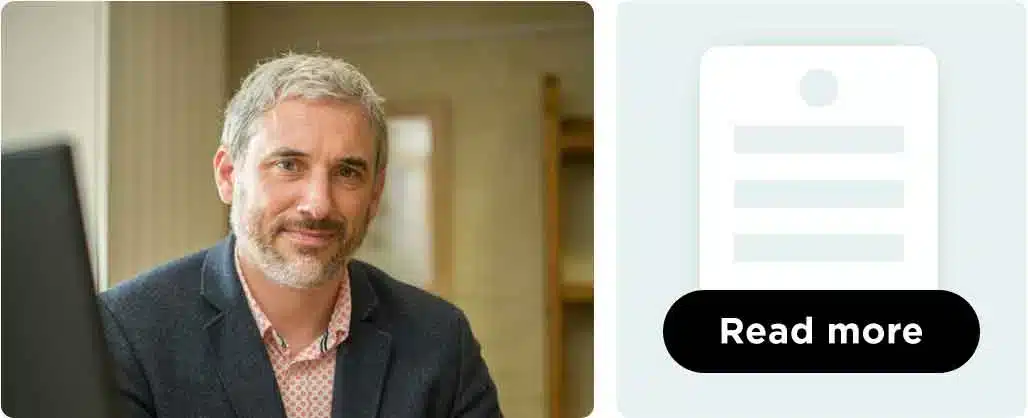
In this episode of The Business of Thinking, Richard Reid speaks with Chris Lovett, coach, author and keynote speaker, about stress, burnout, simplicity and why doing less may be the key to performing better.
Chris’s story begins with an unexpectedly ordinary moment: stepping on a CD case. Specifically, a copy of Mark Morrison’s Return of the Mack, which had been sitting among years of accumulated clutter in his South London flat. That small moment of frustration became a turning point. It made him look around at the amount of stuff he had collected, stored and carried with him, much of which no longer served any purpose.
By the end of that weekend, Chris had sold, donated or recycled hundreds of items. CDs, DVDs, books, clothes, video games and belongings that had once felt important were suddenly revealed as unnecessary weight. The money he made from selling some of those items bought him a plane ticket to Copenhagen, which became the beginning of a much bigger journey.
Over the following months, Chris continued letting go. He sold more possessions, then his flat and car, before taking a sabbatical and travelling the world with little more than a backpack. What he discovered was that many of the richest experiences of life had nothing to do with the things he had spent years accumulating.
That insight did not stay in his personal life. When Chris returned to the corporate world, he began to notice similar patterns at work. People were drowning in meetings, emails, tasks, expectations and responsibilities that had slowly accumulated over time. Much like the clutter in his flat, many of these things had once had a purpose, but were no longer genuinely useful.
This became central to Chris’s work: helping people and organisations use simplicity as a competitive advantage.
One of the most powerful themes in the conversation is the idea of “entrenched narratives”. Over time, we tell ourselves stories about what success should look like. We believe we need the title, the salary, the workload, the constant busyness or the visible commitment to prove our value. In the workplace, busyness often becomes a badge of honour. But as Chris points out, saying yes to everything usually creates chaos rather than high performance.
The alternative is not reckless rebellion. It is small, safe experimentation. Chris suggests starting with tiny acts of simplification, such as leaving a meeting five minutes early when you have another one immediately afterwards, not responding instantly to every message, or questioning whether a recurring meeting is still needed. These actions may feel uncomfortable at first, but they begin to provide evidence that letting go is possible.
For leaders, this matters even more. When people are in back-to-back meetings all day, every day, they are not operating at their best. Chris compares this to athletes: no sprinter trains by sprinting for ten hours straight. High performance requires rest, recovery and intentional use of energy. Yet many professionals still skip lunch, ignore breaks, work late and expect their brain to perform at the same level all day.
This is a false economy. Attention drops. Listening declines. Decision-making suffers. Creativity narrows. The longer people push beyond their limits, the more likely they are to make mistakes that may not become visible until much later.
Chris also challenges the idea that the best work happens through constant effort. Some of the most useful ideas arrive away from the screen: in the shower, on a walk, while driving, resting or even being bored. Boredom, he argues, is not empty time. It gives the brain space to connect ideas in new ways.
For entrepreneurs, leaders and busy professionals, his advice is practical: stop assuming harder work is always the answer. Notice where your ideas actually come from. Capture them quickly when they appear. Create space for boredom, reflection and recovery. Design your working life around impact, not just activity.
Chris’s book Relentless was written for people who feel they are too busy to read a business book. Short, practical and intentionally easy to dip into, it reflects the same philosophy he teaches: less noise, less pressure, less unnecessary complexity.
The message from this conversation is timely and important. In a world that constantly tells us to do more, add more and push harder, Chris offers a different path.
Before you add the next task, commitment or ambition, ask what you could let go of first.
Because less may not mean lower ambition. It may be the very thing that allows you to achieve what matters most.